The Chaoyang Court of Beijing once publicly rendered a judgment in a Bitcoin mining service contract dispute. The court not only dismissed the plaintiff's claim for the payment of massive Bitcoin profits, but also recommended that administrative authorities clean up and regulate mining activities, which attracted high attention from all sectors of society. As Bitcoin serves as a representative and barometer of cryptocurrencies, the attitude of judicial organs towards it is also of utmost importance. This article will mainly summarize the legal protection boundaries for Bitcoin-related matters based on the case precedents of the courts in Beijing and Shanghai.
Boundary 1:Mining is harmful, mining activities are not protected by law, and may be subject to legal liability.
Boundary II:Losses incurred from investing in virtual currencies are borne at one's own risk, and one cannot demand the other party to return the lost portion on the grounds of claiming the contract is invalid.
Boundary 3:Does not recognize Bitcoin as a circulating currency, but protects it as a general item.
What is Bitcoin? Bitcoin is not a conventional fiat currency issued by governments or banks. It is mainly stored online, with approximately 3,600 new Bitcoins generated daily. It is produced through a specific algorithm via massive computations, a process known as mining. Miners receive two types of rewards during the mining process: a new coin reward for creating a new block, and transaction fees from the transactions within the block. To earn these rewards, miners compete to solve a mathematical problem based on a cryptographic hash algorithm, which involves using Bitcoin mining machines to perform hash algorithm calculations. So, legally speaking, how should we define Bitcoin? Furthermore, there is a bold analogy, though not strictly precise, that seems quite reasonable: Bitcoin is like ivory. Once you possess it, the law protects your ownership, but hunting an elephant to obtain ivory is illegal and criminal, while buying and selling ivory is invalid due to the lack of legal right to demand the court order the other party to deliver the ivory.

By retrieving and summarizing the Beijing and Shanghai court cases involving Bitcoin published on the China Judgments Online, we have summarized the following protection boundaries.
Boundary 1: "Mining" is harmful, the act of "mining" is not protected by law, and may be subject to legal liability. Taking the case of the Chaoyang Court as an example: Basic Facts:Fengfujouxinxin Company signed an agreement with Zhongyan Zhichuang Company, stipulating that Fengfujouxinxin Company would entrust Zhongyan Zhichuang Company to purchase and manage micro-storage space servers (i.e., mining machines), provide data value-added services for Bitcoin mining, and pay for the value-added service revenue. Fengfujouxinxin Company paid a management fee to Zhongyan Zhichuang Company. During the performance of the agreement, Zhongyan Zhichuang Company paid 18.3463 Bitcoin to Fengfujouxinxin Company as data value-added revenue, and paid no further revenue thereafter. Fengfujouxinxin Company repeatedly demanded payment without success and sued the court. Court's View:The court held that such mining activities consume a large amount of energy and produce high carbon emissions, which is detrimental to the optimization of our country's industrial structure, energy conservation and emission reduction, and our country's goals of peaking and neutralizing carbon emissions. Furthermore, the multiple risks arising from the production and trading of virtual currencies, such as the risks of false assets, business failure, and investment speculation, are prominent,harming the public interest . Since the parties signed the mining agency agreement while knowing that mining and Bitcoin trading carried risks, and relevant departments had explicitly prohibited Bitcoin trading, this agreement should be deemed invalid. Therefore, the related property rights generated therefrom should not be protected by law, and the consequences caused by the aforementioned actions should be borne by the parties themselves. Analysis:Globally, a large number of Bitcoin mining machines operate day and night, posing two main hazards: first, they consume massive amounts of electricity. According to the latest data analysis, mining a single Bitcoin currently consumes over 400,000 kilowatt-hours of electricity, which is the monthly electricity consumption of 2,000 ordinary urban households. Second, a paper published in the journal *Nature Climate Change* shows that in 2020, the global production of carbon dioxide from Bitcoin mining reached 69 million tons, exceeding 1% of global carbon dioxide emissions. In September 2021, China issued the *Notice of the National Development and Reform Commission and Other Departments on Rectifying Virtual Currency "Mining" Activities*, beginning to crack down on various "mining" behaviors. Although this regulation is not a mandatory legal or administrative provision, it also reflects the negative attitude of various government departments towards "mining". If a dispute arises regarding the agreements signed for "mining" and an attempt is made to resolve it through legal channels, the contract can still be deemed invalid on the grounds of harming the public interest.Conclusion: "Mining" is analogous to "acquiring ivory". From the perspective that there is no harm without a transaction, "mining" harms the public interest, the behavior is not protected by law, and legal liability may still be pursued. Losses resulting from investing in mining shall be borne by the parties themselves.

Boundary 2: Losses incurred from investing in virtual currencies are borne by the investor, and the investor cannot demand the other party to return the lost portion on the grounds of claiming the contract is invalid. Taking a public case from the Beijing No. 1 Intermediate People's Court as an example: Basic Facts of the Case:Pan transferred 9,029 HT to Yang, entrusting Yang to operate HT, PCI, and other virtual currencies to generate profits. After receiving it, Yang also engaged in virtual currency exchanges and purchases. Later, a loss occurred, and Pan sued the court, demanding Yang return the funds. Court's View:The court held that the case involves online virtual currencies, which are not fiat currencies issued by state authorities and lack monetary attributes such as legal tender status and enforceability. They also lack the legal status equivalent to currency, and cannot and should not be circulated and used as currency in the market. They should not realize their circulation function through exchange with fiat currencies. Furthermore, the PCI involved in this case must be traded through technical means to overseas accounts, a method different from the trading methods of legitimate financial products. Considering the above factors, the investment, trading, or exchange of the aforementioned virtual currencies by Pan and Yang is not protected by law in China.The consequences caused by the aforementioned actions should be borne by the parties themselves. Summary Table of Related Cases
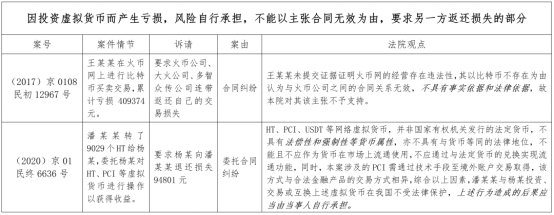
Analysis:The booming market of Bitcoin has driven the rapid expansion of the crypto industry, leading to a proliferation of investment and wealth management related to virtual currencies. Where there is a place, there is a community, and where there is wealth management, there is a risk of loss. According to the "Notice on Further Preventing and Handling the Risks of Virtual Currency Trading Speculation" (Yinfa [2021] No. 237): "Virtual currencies do not have the same legal status as fiat currencies. Virtual currencies such as Bitcoin, Ethereum, and Tether have the main characteristics of being issued and used without a monetary authority, utilizing encryption technology and distributed accounts or similar technologies, and existing in digital form. They lack legal tender status and should not and cannot be circulated and used as currency in the market." "Any legal person, non-legal organization, or natural person investing in virtual currencies and related derivatives that violates public order and good morals shall have their relevant civil legal acts deemed invalid, and they shall bear the losses arising therefrom themselves; those suspected of disrupting the financial order or endangering financial security shall be investigated and dealt with by the relevant authorities in accordance with the law." Conclusion: Comparing the investment in Bitcoin to investing in ivory, if the ivory depreciates, the investor cannot claim compensation for losses from the other party based on the invalidity of the contract. The difference is that ivory investment is not common and will be severely cracked down upon.

Boundary Three: Not recognizing Bitcoin as a circulating currency, but protecting it as a general item. Taking the public case of Shanghai No. 1 Intermediate People's Court as an example Basic Facts of the Case:Brandon and Li forced to transfer their 18.88 Bitcoins and 6,466 Skycoins to an account designated by Yan and others. Later, Brandon and Li sued the court, demanding the return of the funds from Yan and others. Court's View:The court believes that to obtain Bitcoin, one must invest material capital to purchase and maintain dedicated machines with considerable computing power, pay the corresponding price for the power and energy consumed by machine operations, and also expend a considerable time cost. This process and the resulting labor product embody abstract human labor. At the same time, Bitcoin can be transferred for a price of money and generate economic returns. Because Bitcoin possesses characteristics such as value, scarcity, and disposability, it has the features of a right object and meets the constituent requirements of virtual property. The People's Bank of China and other ministries have issued documents such as the "Notice on Preventing Bitcoin Risks" (2013) and the "Announcement on Preventing Token Issuance and Financing Risks" (2017). Although these documents deny the legal status of such "virtual currencies" as currency, the above provisions do not deny their property attributes as commodities, and Chinese laws and administrative regulations also do not prohibit the holding of Bitcoin. The "Notice on Preventing Bitcoin Risks" further mentions that, "in terms of nature, Bitcoin should be a specific virtual commodity."Therefore, Bitcoin possesses the attributes of virtual property and virtual commodities, and should be protected by law.Summary Table of Related Cases
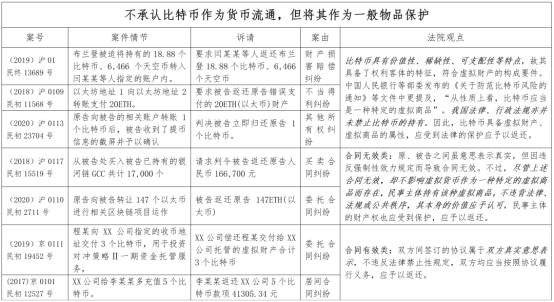
Analysis:Although our country prohibits "mining" and the investment and trading of virtual currencies, our laws and administrative regulations do not prohibit the holding of Bitcoin. Furthermore, in many cases, Bitcoin still holds a high value and has already triggered disputes such as loan disputes and ownership disputes. The "Notice on Preventing Bitcoin Risks" mentions that "in terms of nature, Bitcoin should be a specific virtual commodity," therefore, Bitcoin possesses the attributes of virtual property and virtual commodities. A search of similar cases adjudicated by the courts in Beijing and Shanghai shows that the judicial views are basically consistent: when an individual holds Bitcoin and claims the return of the original item in disputes such as unjust enrichment, ownership disputes, or private lending disputes, it should be protected by the law just like any other item. Conclusion: Holding Bitcoin is analogous to owning an ivory tusk. Outsiders cannot steal it, nor can they borrow it without returning it. If the other party damages or misappropriates the ivory tusk, they should bear the responsibility for compensation for damages and the return of the original item.
